
Today I come here with a broken heart. Actually it has been broken for a while, perhaps since the day I sent an article to a family member, which agreed with their point of view, and they responded with how they don’t read ‘mainstream’ news. But that’s another story.
I suspect that I’m not alone in my injured heart, you too might be feeling a heaviness in your heart with our national crisis and the state of emergency in Ottawa. Anne Lamott said that writers should maintain their reverence, a sense of awe, in order to be able to see the world in its fullness and complexities and tell it to others.
So I will muster up my a sense of reverence and courage, along with my broken heart, to tell you a story of an occupation and the sensations that occupations carry.
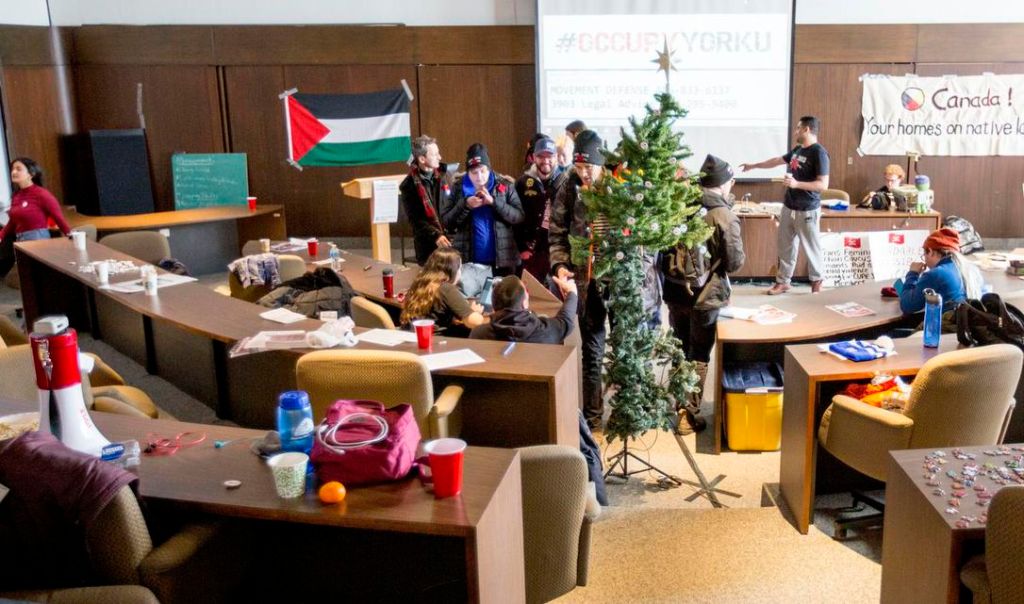
This is a story of an occupation of a room. One room!
The university students were angry. They knew that the university administration hadn’t been negotiating fairly with their professors and teaching assistants who had been on strike for more than two weeks already. The university was keeping some classes open – the ones taught by full-time faculty – and thus forcing the students to cross the picket lines of their other professors. They had written letters and petitions asking the administration to either cancel classes or resume labour negotiations. They had done peaceful protests repeating their needs and they felt everything they had said and done fell on deaf ears.
There was a meeting that day by the top university officials and some full-time faculty members and there was a motion on the agenda regarding whether or not the university should cancel all classes. There were many full-time professors in that meeting who would support cancelling the remaining classes out of solidarity and a sense of community. There were other faculty members that did not support that action.
The undergraduate were frustrated and didn’t know how the vote was going to go. In their frustration and anger at what was happening to their education and to their professors and TAs on strike, they rose up. They disrupted the meeting by walking in. They were stopped by the security forces at first but they pushed their ways in and started a sit-in, interrupting the meeting and not even allowing for the motion to be read.
Thus began a several-months long occupation of THE room by these students. Brave students who would risk a lot, who would ask their parents to bring them pillows and blankets and food, sleeping in the room day and night in the attempt to pressure the administration that had chosen profit over their education.
The students were our supporters, young and full of passion believing that a better education system was possible.
I was among the strikers at the time. The strike that lasted over 5 months and its brutality left its scars on my mind and body both figuratively and literally. I have acne scars on my cheeks because my skin was breaking out due to the combination of enormous stress, long hours out in the cold on the picket lines, and not eating proper food.
In my view, and I’m not alone in that, we the workers lost that fight. The university lost and so did the students. Everyone lost. One of the profoundest lesson of that strike was that if you don’t have public sympathy and support it will become near impossible to win your cause. I’ve been part of another strike where the public sympathy and support was much higher and we ‘won’ as much as we could.
It is both incredible and heart-wrenching to witness the powers of capitalism on one’s body. It’s one thing to read about it in one’s political philosophy class, it’s another to come to feel its force when it is challenged. Heaven forbid if the protest in question disrupts an oil pipeline that destroys Indigenous land and livelihood, or whether the protest is to hold world powers accountable for their in-actions towards the working class and our environment, because then with a force so brutal and swift capitalism will unleash its long tentacles to suppress, suppress, suppress. After the strike, the university made an attempt to expel some of the students involved in such actions. They were not successful.
But I wanted to explore something else here: the affects of an occupation. The sensations of occupation are vast. They spill over from the occupied space and affect other places and beings. They can show up randomly through a post of a relative on Instagram or on the pages of a writer in another corner of the internet.
An occupation has its own forces of sensations. Fear, anger and the sense of justice that has been violated are intertwined with the love – yes, love – for the ideals that one is working towards and the hatred towards that which prevents it from becoming realized.
An occupation carries with it the feelings of the oppressed or those who view themselves as the oppressed. Is there a difference between the two? I wonder sometimes. If as Thomas King wrote ‘the stories that we tell about ourselves make us who we are’ then those who view themselves as oppressed will act as the oppressed. They will resist and attempt to ‘take back the power’ or at the very least redistribute it.
And power is a thing of the senses. It is an affective formation. An occupation’s forces grow and morph into something that sometimes is so far away from the original goal. It metastasizes and becomes unyielding. Any challenge to this affective force is seen as a threat. Any help withheld from it is seen as a way to undermine the cause. What is the cause you might ask?
The occupiers no longer remember. ‘The cause’ was swallowed long time ago by the forces of the power that the occupation brought forth. The sensations of an occupation are that of hunger, a hunger that is not satiated. It wants to consume. It has a desire to swallow whole. And this sensation has a tendency to escalate. It will escalate matters in the attempt to feed that all-consuming hunger. An occupation will also come with an enormous sense of victory for the occupiers. Reclamation is delicious. In reclamation you can feel the electrifying sensations of that harnessed power in the palms of your hands as you raise a banner or a flag. You can feel the intensity of it in your feet carrying you forward in the march on the street regardless of the sub-zero temperature.
And when these forces and all these bodies come together, the space itself becomes electrifying. The forces of anger, hope and solidarity among a group that seems unified in their cause is the very stuff of belonging. It makes people fall in love and create new families with these newly found siblings who are united with them. Its energy surges through those people and will fill them with gratification at least for a while. But when all the dust settles it will be revealed how that energy surge that gratified some, severely damaged the relationships between those people and their communities.
An occupation is built on fragile grounds. Desperation is what has given birth to the occupation and its sensations lead people to take desperate actions. And desperate actions often have an element of violence within them, whether that violence is inflicted on the self or on others. I can tell you that once a situation gets to the point of an occupation, that means things have gone very very poorly from the perspective of the occupiers/re-claimers. They believe that their actions are one of their last resorts to gain what they want.
During my 5-month long strike, there were actions taken that I vehemently disagreed with. The labour talks had stalled, the university was no longer coming to the table waiting out the result of the provincial election with the hope and goal that the Conservative government would legislate us back to work (which sadly they did!). We knew this was the tactic and the long months of the picket lines, being away from one’s research and students, living on strike pay, and the internal disagreements had worn away at people and the desperation, bitterness and the injury to people’s bodies and souls were severe. Both the strikers and their allies would do actions that I would very much disagree with, actions that I wouldn’t condone and what ultimately led to me reducing my participation in the strike. People who fight for the same goals are never a homogeneous group. They do not all believe or condone the actions and behaviours of their comrades and they too sometimes wish there was a better way to resolve their dispute.
When I look back, I keep asking myself what did those student and us needed at that time in order to leave THE room. I don’t know…it has been years and I’m still searching for answers. Perhaps we all needed a restorative mediator, an elder, sitting down with us and guiding a respectful conversation, drawing out our interests versus our positions. But the thing about mediation is that both parties have to come to the table voluntarily and they have to agree that the goal is not to humiliate or shame the other party, rather work together to solve their collective problem.
I don’t know what the answer is, but I do know this: forces of an occupation will affect you. You might find yourself losing your concentration and you won’t be able to function at full capacity because of the grief about what has taken to arrive to this point and the fear at what else could happen. Allow yourself time and space to move through the thick and complex sensations of this occupation.
It will hard, but as Glennon Doyle write: “we can do hard things.”
 Affects of Conflict